BodyReno · Dubai and worldwide

Full range.
Under load.
Without pain.

Squat, deadlift, press and pull — trained to a standard most capable adults have never been progressed to. Not because they lack the strength. Because nobody ever built the sequence that earns it.

A full evaluation across five capability domains, at no cost. Blood panel is arranged separately and not included.

Any capable adult, systematically progressed to strength, control and pain-free capability on the compound lifts.

The situation

You have every input.
What's missing is the architecture.

There's probably a lift you've quietly stopped doing. Or a weight you don't go near any more. Nobody told you to stop — you worked around it once, then again, and at some point working around it became the plan.

Meanwhile the advice keeps arriving, and none of it is wrong. Train harder. Stay consistent. Give it time. You're already doing all of that, which is exactly why more of it isn't the answer.

You have a physiotherapist who knows one joint. A trainer who knows your sessions. Bloodwork you read yourself. All of it real, all of it competent — and not one of those people is looking at the whole thing. The person holding the full picture is you, on top of everything else you're already holding.

So the question nobody is answering is the one that actually matters: why does that movement still hurt, what has to be rebuilt before it stops, and in what order.

That gap is why progress stalls at a point and won't move past it. What an input produces doesn't stay on its own — it stays when there's capability underneath to hold it. Without that layer, results are rented. They belong to whatever produced them, and they leave when it does.

What the work produces

The full range of adaptations.

Most programmes lead with a number — ten kilos, five percent, gone by summer. We don't promise numbers, because nobody can honestly predict yours. What happens instead is plainer: your capability is measured, the programme is built to what the measurement shows, and then it's measured again.

Body composition has been the industry's proxy for progress for so long that it hijacks every conversation about training. It is one legitimate outcome. It is not the whole picture, and it is not where the work ends.

Physiologic
  • Cardiorespiratory efficiency
  • Endocrine & serum lipid adaptations
  • Metabolic efficiency
  • Bone density
Physical
  • Increased lean body mass
  • Tissue tensile strength across tendons, ligaments and muscles
  • Decreased body fat
Performance
  • Strength
  • Power
  • Endurance
  • Flexibility
  • Speed
  • Agility
  • Balance

On body composition, plainly

Change in body composition is a legitimate byproduct of strength training done properly. If you want to prioritise it and you have the discipline for the nutritional consistency it requires, that is supported here.

What isn't sold is the twelve-week photo — because the twelve-week photo doesn't last, and the strength does.

That is the whole distinction. Results that belong to whatever produced them leave when it does. Results built on capability underneath are yours to keep.

The methodology

Five stages, in sequence.

Each stage prepares the tissue and the nervous system for the one above it. Nothing is skipped, and load is never applied to a pattern that hasn't earned it. The framework is the well-established Optimum Performance Training model, run as BodyReno's process.

If you've done a version of this before — physio, a trainer, Pilates, a plan that started well and quietly stopped — the useful question isn't why did I fail? It's what actually failed? Rarely effort. Almost always the absence of anyone integrating the pieces into one progressive system: physio eases pain, Pilates builds control, a trainer adds strength — but no one owns the whole picture, or the order it should be built in.

That unbuilt layer — the one that sequences the pieces — is the difference here. You're not beginning a fifth attempt. You're beginning the first one that was ever structured.

One thing does not wait its turn. Cardiovascular work runs continuously alongside every stage, and VO₂ max is tested rather than assumed — because aerobic capacity underwrites everything above it, and it is one of the clearest reads available on how the system is actually doing.

How to tell whether your training is actually being coached →

01
The filter

Stabilisation Endurance

Mobility, joint integrity, structural preparation. This is not the boring prelude to the real work — it is what earns you access to the real work. It's also the stage that separates people who go on to train properly from people who don't.

02

Strength Endurance

The transition. Load is introduced through patterns that have been stabilised first.

03

Muscular Development

Hypertrophy work. The tissue adapts to the demand being placed on it.

04

Maximal Strength

The heavy compound work. Squat, deadlift, press and pull — loaded, and confident.

05

Power

The highest expression of the sequence, applied selectively and only where it serves you.
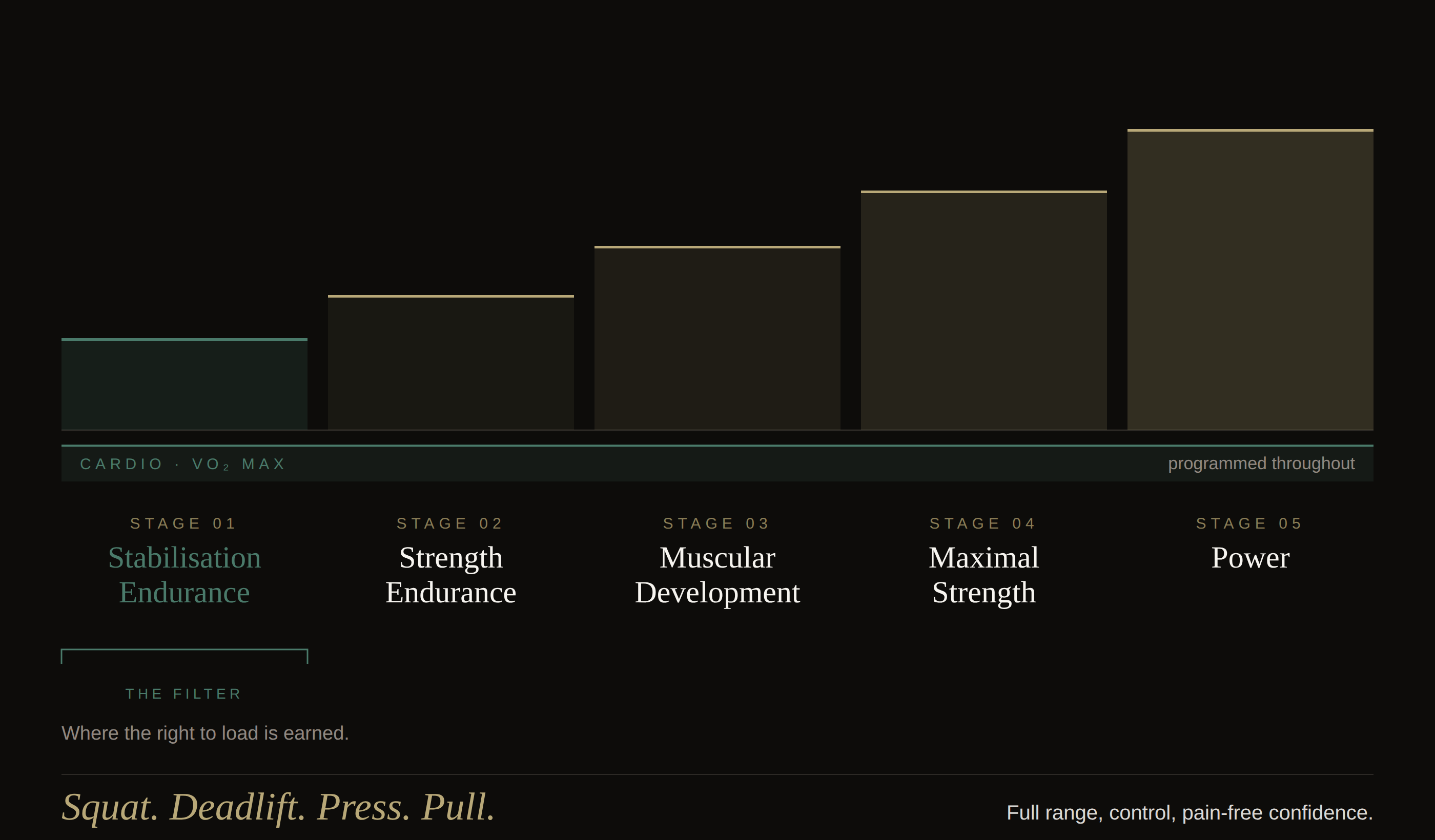
The five stages of progression, ascending, with stabilisation as the filter.
The sequence, and where it arrives. Cardiovascular work and VO₂ max testing run continuously across every stage.
If you're starting out

You're not behind.
You're un-started.

Those are different things, and the second one is far easier to fix.

Instagram has given a lot of people a distorted picture of what training is. Enormous lifts. Physiques that took a decade and a particular set of circumstances. Movements filmed from the one angle that makes them look effortless. None of it tells you where to begin — and it quietly implies that everyone already knows something you don't.

Mostly, they don't.

Here's the thing almost nobody explains. A workout is a session. A programme is a sequence of sessions that know about each other — where what you did last week determines what you do this week, and where every session is building toward something specific and measurable.

Most people have never followed one. What they've had is a free PDF, an app, or someone running whatever seemed reasonable on the day. Those are workouts. They can be enjoyable, and they will certainly make you tired. They won't reliably take you anywhere in particular.

And if you are starting from nothing, you have an advantage most people in that gym would want back: there is nothing to undo.

No years of compensations. No pattern learned badly and then repeated ten thousand times. No attachment to a number that has you training around an injury instead of resolving it. You get to build it in the right order, from the start — which is considerably easier than rebuilding it at forty-five.

The assessment is where that begins, and there is nothing to prepare for. It measures where you are today. Nobody is scored against anybody else, and there is no standard you need to reach before you're allowed to start.

The standard

Three non-negotiables.

Every programme is built on three things. If any one of them is missing, a client isn't following a programme — they're exercising. We don't let that happen.

01

Proper execution

Full range appropriate to the goal. Controlled tempo. Technique that holds under fatigue — actively coached, not counted from across the room. Difficulty is not the same as quality, and a hard session moved badly is still a session moved badly.

The five checks, in detail →

02

Progressive overload

A measured baseline, recorded loads, and a planned route by which demand increases. Progression is load, reps, sets, range of motion, tempo, density, exercise complexity and total volume — eight levers, not one. If it isn't recorded, it isn't being managed.

What real progress tracking looks like →

03

Periodisation

Defined phases, each with a reason and a relationship to the one after it. Volume and intensity matched to the phase. Recovery planned into the programme rather than arriving when something breaks.

Why training needs a plan →

What you should expect

From any starting point: the compound movements trained with full range, control and pain-free confidence — at loads you did not previously believe you had access to.

That is a concrete claim, and an uncommon one. Most capable adults in their forties and fifties cannot perform a full-range unloaded back squat with control. That is the gap the sequence closes.

Built on principles that hold across decades, not weeks. It is a practice, not an event — which is precisely why the result is still there in two years.

And it is measured repeatedly. Roughly every twelve weeks you take the same assessment again — the same domains, the same scoring, the same bar. Not a finish line: a checkpoint. You won't be asked whether it feels different. You'll be shown what changed — and the next block is shaped by what the last one actually produced.

In their words

The result of a structured approach.

A selection from verified, publicly listed Google reviews. The pattern is consistent: a system rather than a workout — position and stability first, strength built on a corrected foundation, and the behaviour coached around a real life so the result holds.

"Instead of jumping straight into heavy lifting, Nathan started with stability, mobility and posture, and built a solid foundation first. It combines the best of personal training and physiotherapy."
Marie-Sophie
★★★★★ · Google
"The first personal trainer I've ever used that looks at abilities holistically. I've changed the way I do squats and quickly increased my weights — really noticing a difference."
Catherine Clifford
★★★★★ · Google
"The best preparation choice I could have made before Kilimanjaro. He tailored my training to include stability and mobility — I descended a steep mountain dog-tired and without fear of injury."
Faheem A.
★★★★★ · Google
"Incredibly thoughtful, with a very structured, well-planned approach to every session. A clear system and methodology — and you can see that structure translating into real, sustainable results."
Aki Mishra
★★★★★ · Google
"He coaches your mindset alongside your body, and helps you understand why things work — not just what to do. That shift in thinking is what makes the results stick."
Abu Jihad
★★★★★ · Google
"My entire approach to working out changed — training smarter, with more focus on weights. More definition, more energy, and the importance of protein made a huge difference."
Sonali Punj
★★★★★ · Google

Reviews are publicly listed on Google.

The founder
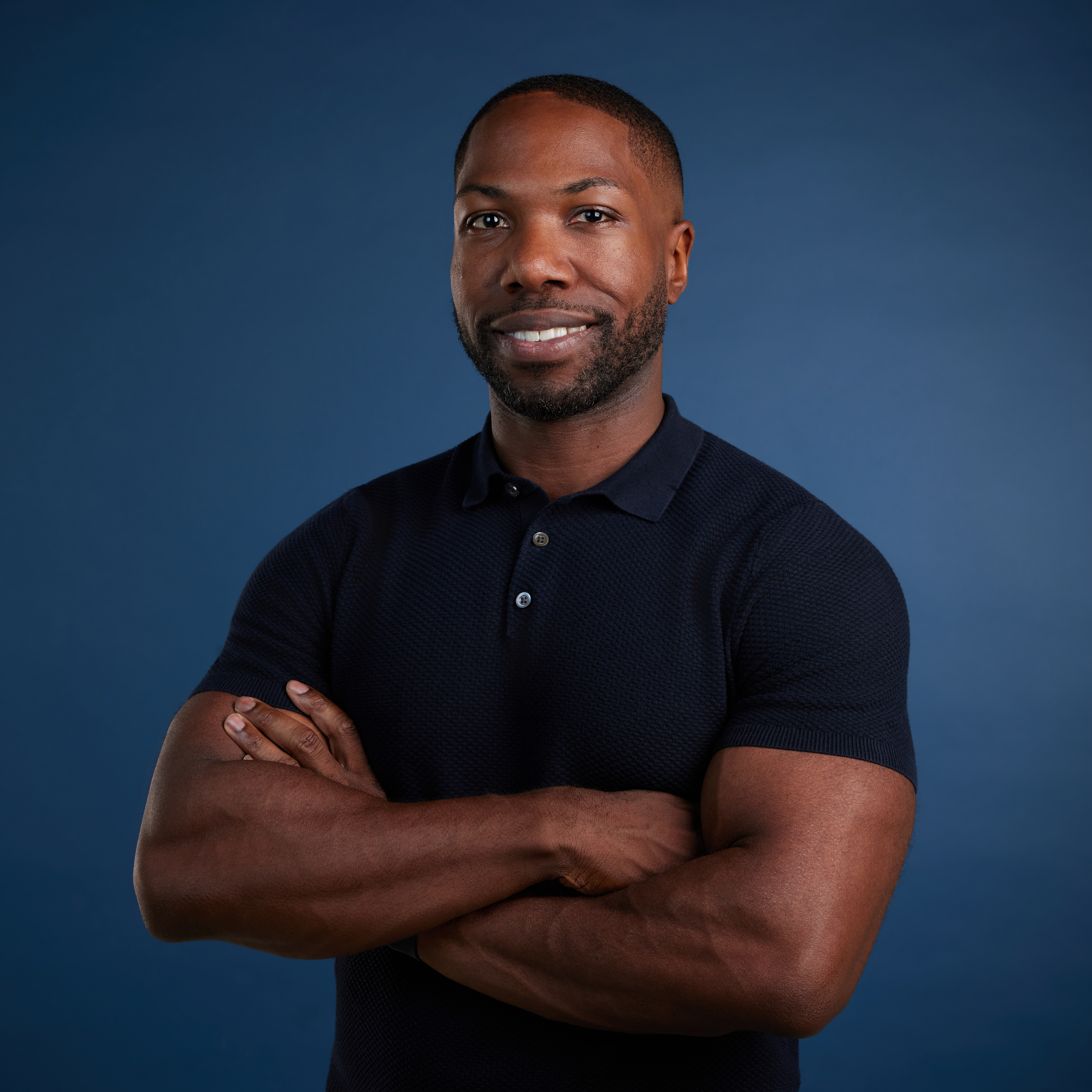
Nathan Stephenson
Nathan Stephenson
Movement Longevity Specialist

I spent years without the answer.

Early on, the same problem kept walking through the door and I couldn't solve it.

Someone capable, motivated, fit by most reasonable measures — and they couldn't get their arms overhead without their ribs flaring open. Or they couldn't hold the bottom of a squat with any control at all. I could see something was wrong. I couldn't tell you what it was, and I couldn't tell you what to do about it.

That was close to embarrassing, and it stayed with me. It is the reason I built what I built.

Now, five minutes of static and dynamic postural assessment tells me what is happening in a body and why. Not a guess — a read. Where the restriction sits, what is compensating for it, and what has to be addressed before anything gets loaded.

Any capable adult can squat, deadlift and press under real load, through full range, without pain — once the foundations are laid.

The problem was never capacity. It is that almost nobody takes the time to assess properly and build those foundations first. That work is unglamorous. It doesn't look like training is supposed to look, and it asks people to spend weeks on things that don't feel like progress.

There's a related point worth making plainly, because it shapes how people choose. A great physique demonstrates that someone has successfully trained themselves. It doesn't demonstrate that they can assess, programme and coach somebody else. That's a different skill, and it's the one I've spent eleven years building.

But the clients who have trusted that process have gone on to strength they didn't believe was still available to them. Not a handful of them. That's the pattern.

Twenty years training myself. Eleven years coaching professionally. Still learning today. The standard isn't perfection — it's having a process for getting better, and applying it to every client the same way I apply it to myself.

  • Over eleven years in structured physical development
  • More than ten thousand one-to-one sessions
  • Five years building every programme on the Optimum Performance Training (OPT) model
  • Specialist in proprioception, structural resilience and high-functioning longevity
  • Based in Dubai — in person locally, remotely worldwide
Where it starts

A free physical assessment.

Before anything is programmed, your capability is measured properly — across the five domains, with the same instruments every time it's repeated, so progress is verified against a real baseline rather than a feeling.

  • Body composition & metabolic baseline — including VO₂ max
  • Posture & structural alignment
  • Mobility & range of motion
  • Stability, balance & proprioception
  • Strength & physical capability

Most people will spend days researching a car, a house, a phone, even a holiday. Health tends to get a fraction of that scrutiny — often reduced to "he looks like he's in shape, so he must know what he's doing." Where price does get compared, it's almost always per session — the one number in the decision that tells you nothing about whether the training will actually work.

Your body deserves the same process, evidence and review you'd bring to any other serious investment. That's what the assessment is: the diligence step, done properly, before anyone commits to anything.

Scope: the physical assessment is at no cost. A blood panel is a separate clinical service, arranged with a partner physician where it's useful — it is not included here, and it isn't required to begin.

Entry is by assessment. The work suits capable adults ready to be progressed systematically — which is something the assessment establishes, in both directions.

And the aim, in time, is a system you can run without needing anyone — because the goal was never dependence. It was capability that holds.